- Clipsal extends Iconic range
- Australia’s acoustic sensors market set for solid growth
- Energy storage specialist opens Australian office
- Firmware upgrade for measurement amplifiers
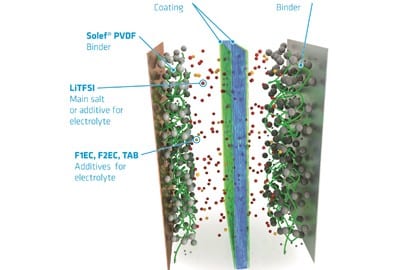
Solvay has new innovative Solef polyvinylidene fluoride (PVDF) electrode binders designed to boost the electrical performance of high-energy lithium-ion batteries (Li-ion) for hybrid as well as pure Electric Vehicles (xEV).
Solef 5140 electrode binders are prepared using a proprietary polymerisation technology that allows Solvay to chemically modify the PVDF polymer and achieve ultra-high molecular weight in a tightly controlled process. These features result in enhanced adhesion and cohesion properties required for high energy electrode binder formulations for xEV battery applications.
In addition, Solef 5140 offers good cohesion between the active material particles as well as the conductive agents to ensure longer cycle life and achieve higher energy density. Its polar functional groups distributed in the fluoropolymer chain also result in lower internal resistance. Long-term stability is said to be ensured by the binder’s chemical resistance in the aggressive environment of Li-ion cells, which includes organic carbonates and lithium salts. The new binder grade extends the existing family of Solvay’s Solef 5130 and Solef 5120 PVDF binders for cathodes and anodes.
This Solef grade displays good performance in the high nickel (Ni) content of state-of-the-art Ni-Mn-Co (NMC) and Ni-Co-Al (NCA) high energy cathodes, especially to resist the formation of gel during slurry preparation, which distinguishes them from competitive grades.
Complementary technologies from Solvay designed to reduce weight, enhance the structural strength and maximise the electrical efficiency of xEV Li-ion battery module/packs include a broad range of proven high-performance polymer compounds, separator coating materials and functional additives for electrolyte.