- Clipsal extends Iconic range
- Australia’s acoustic sensors market set for solid growth
- Energy storage specialist opens Australian office
- Firmware upgrade for measurement amplifiers
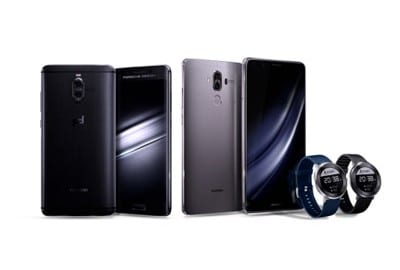
Huawei Consumer Business Group has unveiled the Huawei Mate 9 and the Porsche Design Huawei Mate 9 mobile smartphones. The newest members of the Mate Series feature the Kirin 960, which is claimed to offer the fastest computing performance, SuperCharge technology and a new UX.
“In developing the HUAWEI Mate 9, we started with a simple question – how can we improve every element of the smartphone experience?” said Richard Yu, CEO, Huawei Consumer Business Group. “We know that for today’s business users, a fast and functional smartphone is just the beginning. Consumers also want a gorgeous design and intuitive features, so we created two new devices at the forefront of hardware and software innovation. The result is the new Mate Series, breathtakingly new, inside and out.”
The HUAWEI Mate 9 features an interplay of hardware and software that work together to keep users a step ahead. Key features include:
- Kirin 960 chipset
- EMUI 5.0, an intuitive user interface that streamlines the users’ experience with the OS
- SuperCharge technology that delivers a full day’s charge in 20 minutes
- Second generation Leica dual-lens camera with 12-megapixel RGB sensor, 20-megapixel monochrome sensor and Hybrid Zoom, featuring a superior 2x magnification
Kirin chipsets come with Huawei’s Machine Learning Algorithm to deliver a fast and smooth experience, even after 18 months of continuous usage, says the company.
The chipset has an ARM Cortex-A73/A53 Octa-core CPU and Mali G71 Octa-core GPU. The CPU is said to delivers multi-core performance, while reducing power consumption by 15 per cent. The GPU is said to have a 180 per cent performance uplift and a 40 per cent improvement in energy efficiency compared to its predecessor. The Kirin 960 also takes advantage of the Vulkan graphics standard on Android 7.0, increasing graphics performance by up to 400 per cent.
The Mate 9 combines a 4000 mAh high-density battery with Huawei’s SuperCharge technology. The device is said to have an increased battery life to provide over two days of uninterrupted performance. This includes a 40 per cent increase in CDMA call time and a 20 per cent increase in gaming time.
Supporting 5A fast charging, SuperCharge technology enables a 50 per cent improvement over the previous generation – 10 minutes of charge provides enough power to watch two movies. The battery charging technology includes Super Safe 5-gate protection, which offers real-time voltage, current and temperature monitoring to eliminate safety hazards and safeguard battery life.
This device features the second generation dual-lens camera co-engineered with Leica, which includes a 12-megapixel/F2.2 RGB sensor, a 20-megapixel/F2.2 monochrome sensor and enhanced image fusion algorithms.
The RGB sensor captures true-to-life colours, while the monochrome sensor captures intricate details and depth. When paired with the dual-lens camera Optical Image Stabilisation (OIS) solution and the dual-camera pixel binning technology, the Mate 9 has suitable for night shoots. The Kirin 960 is designed to support the unit’s second generation Leica dual-lens camera with Hybrid Zoom. The 4-1 Hybrid Auto-focus features laser focus, phase detection focus, depth focus and contrast focus.
It has a 5.9-inch FHD display. Based on a process of research and development, the Huawei Mate 9 is constructed using 50 processes including one hour of CNC milling, resulting in a high-precision unibody metal frame.
The Porsche Design Huawei Mate 9 is a limited-edition smartphone combining Porsche Design’s signature brand aesthetic with Huawei’s mobile engineering expertise. It has a 5.5-inch curved AMOLED display that offers a smooth, sleek feel.
With the introduction of EMUI 5.0, the handset reimagines the native Android operating system using Linux to improve the experience, aesthetics and functionality, says the manufacturer. EMUI 5.0 introduces a new intuitive interface design. More than 50 per cent of features can now be reached within two clicks while over 90 per cent can be reached within three clicks.