- Liquid fuel for future computers
- Global standard for street light products
- Panasonic capacitors handle high temperatures
- Plastic electrode stretches like rubber but carries electricity like wires
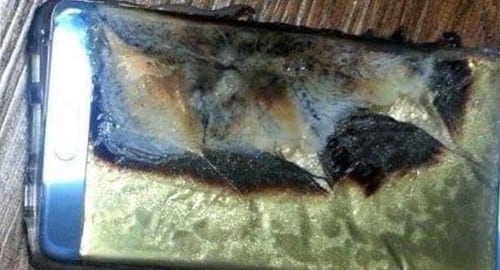
Unless you’ve been hiding under a rock over the past six months, you’ll know that Samsung has had a marketing disaster on its hands with the Galaxy Note 7 after more than 30 of the units caught fire and/or exploded.
Samsung did the right thing – they stopped selling the device, issued a recall, and promised to replace the handset with a new one once the problem had been rectified. Unfortunately, the replacement option ended in a catastrophe when up to five of the new versions also exploded.
Some industry experts are saying that Samsung should stick a fork in the device and delete it from its inventory, which could happen. The Galaxy Note 7 brand is toxic and could have a negative knock-on effect to other Samsung devices, such as laptops, tablets and its other handsets.
The issue is the battery. In almost every case, the critical failure happened when the device was being charged. Galaxy Note 7s use lithium-ion batteries that come with a highly flammable liquid inside, which in itself is not an issue as long as it is contained. Samsung is not saying what happened yet, but one theory is that during the manufacturing process, a hole or fracture has appeared within the veneer-thin piece of plastic that separates the positive and negative sides of the battery. This in turn becomes the easiest direction for electricity to flow, which heats up the aforementioned volatile liquid, which leads to the critical failure of the device. Another theory is that components were crammed together too tightly to get more battery life and this led to a short circuit occurring.
Probably the most annoying aspect for Samsung is that these issues might only affect up to 1000 units. Yet, with an almost zero tolerance for such a catastrophic event, not least from the manufacturer itself, it has been an unmitigated disaster for the South Korean tech giant.
Where to next? It seems unlikely that the make-up of the battery will change. Until somebody comes up with a battery that is lighter and lasts longer, lithium-ion driven devices are here to stay.
There are a few lessons that Samsung can learn.
1) Is the design of the battery the issue? Probably not. This is because the number of devices that have failed – although alarming – is infinitesimal compared to the number produced. If it was an endemic design defect you would expect 10s of 1000s, if not 100s of 1000s, to have been affected.
2) Was it the manufacturing process? More likely. Sometimes it only takes a slight adjustment here, and slight rejig there in the manufacturing process, to cause the make-up of a product to change. Production lines are run by people, and people make mistakes, so they might get a calculation slightly wrong and think nothing of it. Samsung needs to sit down with its manufacturer and see how they put the device together.
3) The device owners. The one issue out of Samsung’s control. Bearing in mind our main explanation already outlined, the number of fires is so minute that it could well be the devices – inadvertently or otherwise – have been misused by the owners. Maybe it was dropped, or kicked, or thrown, and thus caused cracks to appear.
Whatever is decided, Samsung needs to make some quick decisions and inform the public of the outcome(s). Because while the ‘exploding’ batteries have only affected 100 or so users, the whole event has been a public relations shambles. One that will be repeated if lessons are not learned. Quickly.