- Brother means business with powerful new range
- China Foxconn factory replaces 60,000 workers with robots
- Compliance Map tracks Country of Origin in complex supply chains
- Rapid growth in smart MEMS microphone market expected
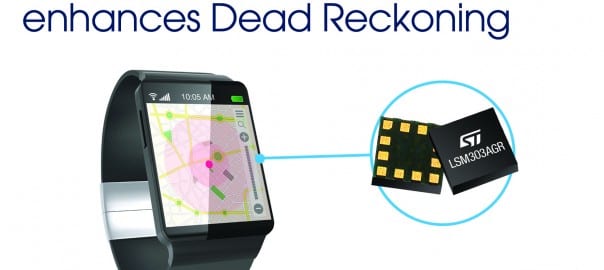
Smart devices are about to get better at guiding users and mapping their sporting achievements even where satellite navigation cannot work, using the latest electronic compass from STMicroelectronics.
Fitness-tracking smartphone apps, smartwatches, and bands need continuous location data for mapping and recording, and accuracy is critical for wearers who like to monitor their progress and share achievements online. A built-in eCompass helps calculate location when satellite signals are unavailable, such as inside buildings or when running or cycling under tree cover. However, current solutions can give errors of about 10° in latitudes such as Northern Italy or Northern California. This can put the user off course by 150 meters or more in every 1000 meters travelled.
ST’s LSM303AGR eCompass cuts the heading error to less than 4°, leveraging the Company’s proprietary technology for manufacturing high-accuracy magnetic sensors. This enhanced accuracy, combined with ultra-low power operation consuming up to 50 per cent less than competing devices when in low-power mode, is particularly well suited to high-precision Pedestrian Dead Reckoning (PDR) on mobile devices.
The LSM303AGR also enhances dead-reckoning accuracy in applications such as automotive navigation, and maintains accuracy over the full temperature range from -40°C to 85°C, whereas competing devices can vary by as much as 35% or more over small intervals such as between normal room temperature and human-body temperature.
“The industry-leading technology behind ST’s new eCompass further extends our lead in MEMS sensing for positioning and motion detection in consumer devices,” said Andrea Onetti, Group Vice President and General Manager of MEMS Sensors Division, STMicroelectronics.
“High-precision PDR, enabled by this device, will significant enhance the user experience delivered by apps including fitness trackers and personal navigation on smartphone and devices like smart watches, which IHS predicts will exceed 100 million units by 2020.”