- Stretchable electronics market forecast to reach $360 Billion
- Renesas Electronics appoints executive vice president
- Toshiba shipping samples of 64-layer, 512 3D Flash memory
- How Lean manufacturing saved an electronics company
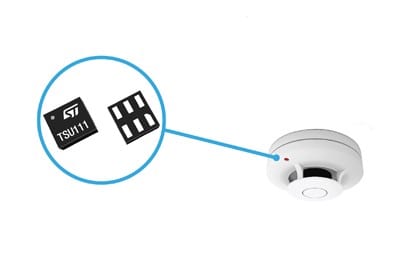
With its tiny 1.2mm x 1.3mm outline and typical current of only 900nA, the TSU111 nano-power op amp helps cut the size and energy needs of analogue circuits to the bare minimum in medical monitors, wearable electronics, gas detectors, pH sensors, infrared motion sensors, and payment tags.
The TSU111’s low operating current is on par with the leakage current of some low-cost capacitors, and would take over 25 years to discharge a 220mAh CR2032 cell. Hence the op amp can be designed-in with negligible impact on overall system energy management.
At the same time, the TSU111 outperforms other nano-power op amps with its input-offset voltage of 150uV and 0.1-10Hz noise of 3.6µVp-p that ensures high accuracy in signal-conditioning circuits.
In addition, the gain-bandwidth product (GBWP) of 11.5kHz and the rail-to-rail input stage enable monitoring of environmental or biological signals. The low input bias current of 10pA helps minimise the effects of parasitic currents in sensing devices like gas detectors or photodiodes.
The supply-voltage range of 1.5V to 5V allows the TSU111 to be powered from the same supply rail as logic circuitry thereby simplifying power-supply design and board layout. Moreover, the low minimum voltage allows the device to run longer as the battery discharges, and simplifies use in equipment powered by energy-harvesting systems such as photovoltaic (PV) cells.
The TSU111 is available in the 1.2mm x 1.3mm DFN6 package or 2mm x 2.1mm SC70-5 (SOT323-5).