- Stretchable electronics market forecast to reach $360 Billion
- Renesas Electronics appoints executive vice president
- Toshiba shipping samples of 64-layer, 512 3D Flash memory
- How Lean manufacturing saved an electronics company
Portability is a key component to a modern working environment and one that Microsoft if keen to expand upon with its latest offering in the laptop/tablet market.
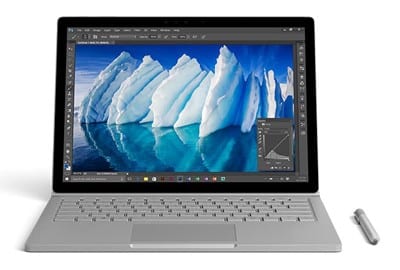
Its next iteration of its Surface Book device – the somewhat clunky-named Surface Book with Performance Base (what we’ll call SBPB for brevity’s sake) – won’t be out until December 8, and the company is pushing hard to let people know that it is more than just a portable workstation.
Microsoft have long dabbled in hardware even though its core business is software. It’s tried hard to make it into the market with varying success, and even though they are taking on vendors whose core business is the solid stuff, such as Apple, Samsung, Lenovo, Acer and HP, it has enough belief in itself to churn out tablets that have found a niche.
Enter the aforementioned SBPB. Aimed at engineers who are more interested in dabbling with drawings using traditional pens and pencils, the SBPB is set to take them that step further – get rid of their luddite tendencies and bring them the future of engineering design.
Microsoft’s US-based Senior Director of Mechanical Design, Andrew Hill, says the conversion rate for engineers is high once they see what the device can do. “Sketches are all well and good and I still doodle, but once I do the sketch it is gone,” he says. “If I want to share it with someone I have to take a photo otherwise it’s a dead thing. When showing old-school engineers the Surface Book and what it can do, we convert people. They get pretty fired up about what it does. The more people that experience it – see it and feel it – the more people get it pretty quickly.”
Hill believes one of the main reasons engineers will be converted to the device is due to its mobility. Not only that, but it has two batteries – one within the unit itself, and one with the lift-off screen that turns into a tablet when it is disengaged from the keyboard. Each separate part has its own processor, too. So to Hill’s way of thinking, users are getting two bites of the cherry with battery and processing power.
Matt Chapman, who is the US-based Product marketing manager for the device believes these features will help sell it. “I was at the Solid Works World Convention last year in the US and people came up to this device and they saw that it can run CAD software and it blew their mind,” says Chapman. “It was because they’re used to these big workstations and big thick laptops and to be able to run CAD software on a device as light as this is game changing.”
And it is light. Surprisingly so. Its shell is made from magnesium, which is lighter than aluminium. It is an issue that Hill is passionate about. “I had a conference call with some folks in my team yesterday on a product they are working on now,” says Hill. “And we discussed [different widgets down to the last] gram as far as weight is concerned.”
At price points between $3800 and $5200 depending on the model, it may seem that is a premium price to pay for a laptop, even with its CAD capabilities. However, Microsoft, Hill and Chapman believe the amount of grunt under its hood makes it a worthwhile investment. Will engineers feel the same way? Guess we’ll find out December 8.