- Stretchable electronics market forecast to reach $360 Billion
- Renesas Electronics appoints executive vice president
- Toshiba shipping samples of 64-layer, 512 3D Flash memory
- How Lean manufacturing saved an electronics company
Bitmovin, the provider of streaming video infrastructure technologies, today released a new video infrastructure API that bundles Bitmovin’s video encoding and video player services with a new video performance analytics product, as well as integrations into various storage and content delivery network (CDN) providers.
The result is an end-to-end video infrastructure API that is said to simplify the development and delivery of web-based video, including live, VOD, 360, and virtual reality.
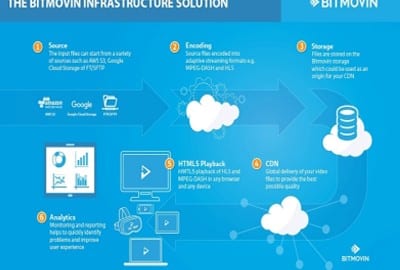
The term “video infrastructure” refers to all of the components required to deliver adaptive streaming video in an online environment. The chain begins with a video file, which is encoded into adaptive streaming format (usually MPEG-DASH and/or HLS) and then transferred to some form of online storage (AWS S3, FTP, Aspera, etc.). From there the files are fed out through a content delivery network, or CDN (Akamai, Level3, CloudFront, etc.), which delivers the video to a user, who watches it through an adaptive player such as an HTML5 Player.
The last piece of the puzzle is the analytics system which tracks user behaviour. On top of this infrastructure is another layer of technologies that are often required. This can include encryption (Digital Rights Management), advertising integrations, VR or 360° video controls, subtitles and closed captions, and many more possibilities.
The use of video has grown so quickly that most video infrastructures are built by patching together systems from a variety of different providers. This results in long and expensive development cycles, complex and unscalable systems, and online video offerings that fall short of the quality found on Netflix, YouTube or Twitch.
The new Bitmovin API combines every component in the adaptive streaming video encoding and playback workflow — encoding, playback, analytics, storage and content delivery — into one single management interface without locking users into a one-size-fits-all solution. Content providers, broadcasters, integrators and developers can combine any part of the new Bitmovin API, or utilise the whole Bitmovin offering, with their existing video infrastructure.
Online video providers such as Ooyala, RTL and Technicolor already use this API in their production environments.