- 10 ways a position sensor can mess up your project
- Invention makes invisible source of PIM visible
- Vehicles – safer, greener and more connected
- V2V chipsets address new vehicle regulation
National Instruments and Australia’s Curtin University have entered into a research collaboration in the field of instrumentation and signal processing techniques for radio astronomy.
Curtin University is the lead in a consortium of 17 institutions from five different countries that are investigating the origins of the universe. Using the Murchison Widefield Array (MWA), a large-scale telescope in the middle of the desert in Western Australia, researchers are collecting data to study the formation of the very first stars and galaxies 13 billion years ago.
Curtin University and National Instruments signed a Memorandum of Understanding (MoU) outlining a two-year partnership where both parties mutually share knowledge in radio telescope technology, engineering and field research. The signing took place during NIWeek in Austin on Aug 2, where MWA Director Dr Randall Wayth, from Curtin’s Faculty of Science and Engineering, presented details of the MWA project to over 4,000 leading engineers, scientists and researchers from around the world during the event’s opening keynote presentation.
“We are immensely pleased to support and collaborate with Curtin University,” says Chandran Nair, Vice President Asia-Pacific at National Instruments. “Our relationship has grown over the years and we highly regard their efforts to drive research in the field of instrumentation and signal processing techniques for radio astronomy.”
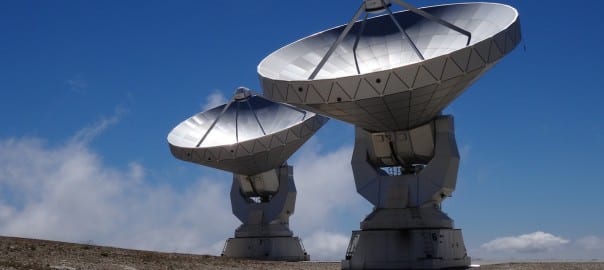
Unlike optical telescopes, radio telescopes such as the MWA consist of a specialised antenna and radio receiver that receive radio waves from astronomical radio sources. The MWA is a phased array system made up of 2048 antennas that can be electronically steered to focus on different parts of the sky.
“The MWA antennas are organised into 128 tiles and for every 8 tiles, we have one receiver system that performs signal digitization and pre-processing,” says Dr Wayth. “Each of these receivers then sends the data over fiber to our central servers where we perform further processing to generate images. NI provides a critical technology for the supercomputer that processes this big analog data.”
MWA researchers are using Commercial off-the-shelf (COTS) digitisers and FPGA (field-programmable gate array) enabled reconfigurable instruments from National Instruments for channelisation, a technique that filters germane frequency bands right at the receiver. Using the FlexRIO along with LabVIEW to program the FPGAs allows researchers to modify and adapt the FPGA code without being VHDL experts.
“The whole array is generating over 300 gigabits of data continuously which downstream servers can’t handle in real-time. Instead of recording all that data, we use FPGAs to pick out only the frequency bands we care about. NI’s instrumentation tools, both hardware and software, give us plenty of room to grow and innovate, from gathering huge amounts of data to processing these meaningfully,” Dr Wayth added.