- Liquid fuel for future computers
- Global standard for street light products
- Panasonic capacitors handle high temperatures
- Plastic electrode stretches like rubber but carries electricity like wires
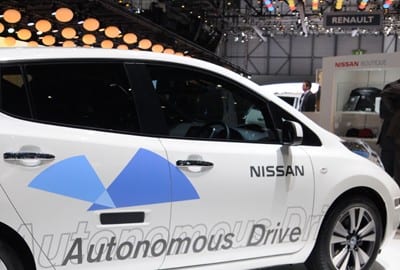
Swedish-based M2M/IoT market research firm Berg Insight claims that autonomous cars will debut in 2020 and by 2030 more than 24 million will be sold.
The active installed base of autonomous cars is forecasted to have reached about 71 million at the end of 2030. These figures include SAE Level 3 and 4 cars. It is important to note that autonomous cars are not a single innovation; rather this technology can be seen as a continuum of various levels of autonomy where the amount of driver involvement is the main differentiating factor.
Several sophisticated technologies must come together to enable a car to safely drive by itself and autonomous cars will therefore roll out in incremental phases. In particular, software for interpreting sensor information and managing the driving logic is key to the development of self-driving cars.
Some automobile manufacturers have initiated projects to develop self-driving features in their cars. The incumbent automakers are joined by multiple new players such as IT companies and other technology-oriented firms.
Most incumbent automotive companies pursue an incremental approach with step-by-step roll-out of autonomous systems while start-ups and IT companies take a more revolutionary direction and aim at developing fully autonomous cars immediately from scratch.
“These pathways do not contradict each other as different autonomous systems are suitable in different use cases,” says Ludvig Barrehag, M2M/IoT analyst at Berg Insight. “We will continue to see development from both sides for still some years before the two approaches converge.”
The advent of autonomous cars is expected to have a tremendous impact on our society in several ways. Cars are costly, as well as inefficiently used, assets. When cars can operate around the clock on a service- based business model it results in a tremendous increase of their utilisation rate. Furthermore, autonomous cars will improve life quality for people unable to drive, reduce the number of fatalities and accidents in road traffic and increase overall traffic efficiency. The economic benefits are vast – the challenge is to succeed in making self-driving cars sufficiently reliable at a reasonable cost to enable commercialisation.